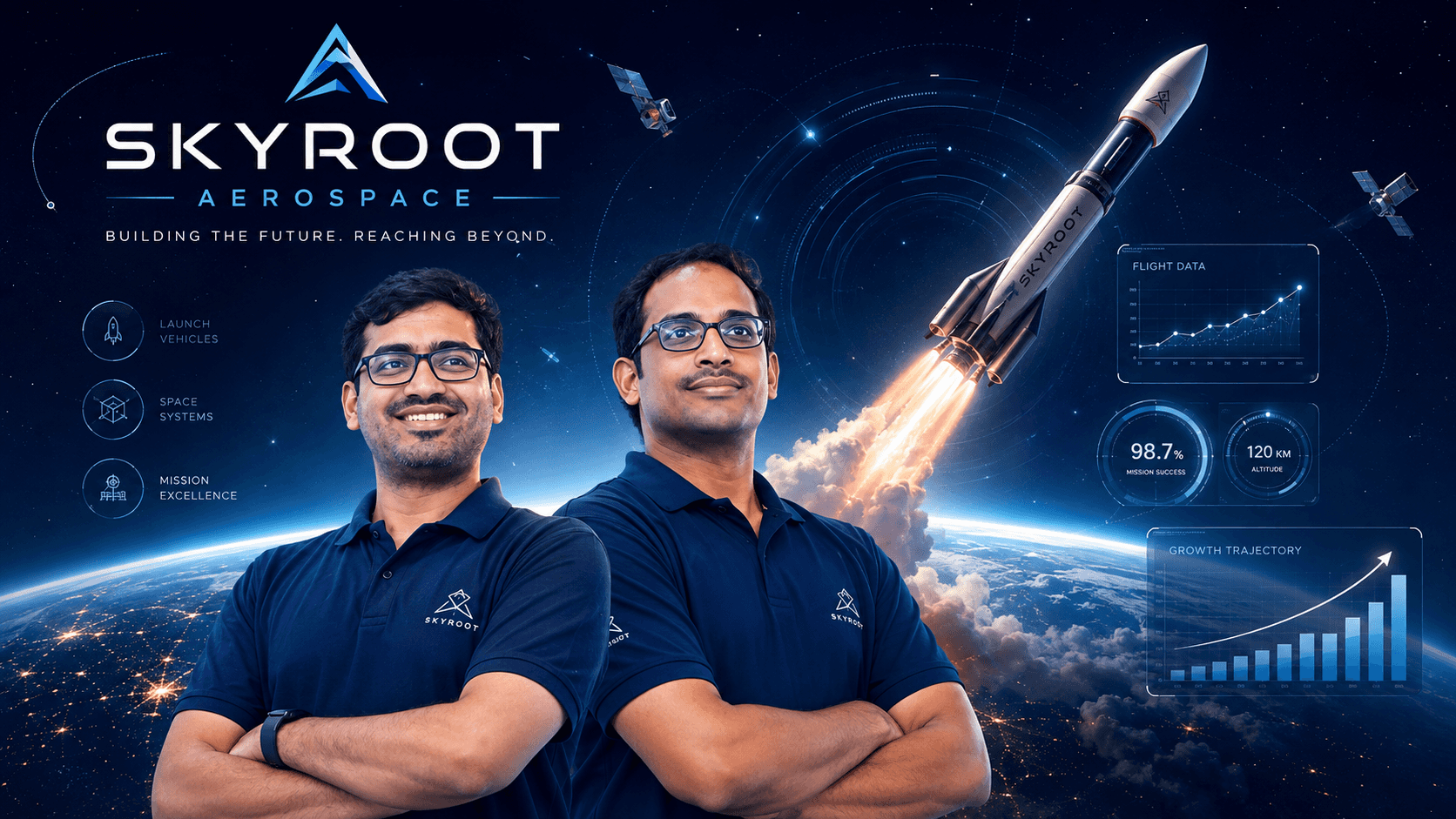
Indian space startup Skyroot Aerospace opens bids for $200 million capital raise, signaling major investor confidence in deep tech and private space ventures.
Skyroot Aerospace, a prominent trailblazer in India's burgeoning private space industry, is actively soliciting bids to raise $200 million at an ambitious $2 billion valuation. This significant capital infusion, if successfully executed, represents a critical inflection point for India's deep tech ecosystem and further validates investor confidence in long-term, capital-intensive ventures operating outside traditional Silicon Valley strongholds. The proposed round holds the potential to substantially reshape investment dynamics within the rapidly expanding global space economy, signaling a shift in where frontier technologies are cultivated and funded.
The proposed funding round represents a substantial leap for the Hyderabad-based startup, coming amidst a broader recalibration across global venture capital markets where mega-rounds are increasingly scrutinized for their fundamental underpinnings. Achieving a $2 billion valuation would position Skyroot among an elite cadre of private space companies worldwide, underscoring the strategic premium now being assigned to independent capabilities in launch services and satellite deployment infrastructure. These foundational elements are crucial to the new space economy, enabling everything from broadband internet constellations to sophisticated earth observation platforms. The $200 million infusion is specifically earmarked for accelerating vital research and development, scaling manufacturing capabilities for its innovative 'Vikram' series of launch vehicles, and expanding its operational footprint to meet the burgeoning global demand for small satellite launches. This substantial capital injection is absolutely crucial for sustaining the high burn rate inherent in cutting-edge aerospace innovation and for securing a competitive edge against a rapidly evolving landscape of established international players and emerging startups alike.
The deal terms suggest a strong belief in Skyroot's technological roadmap and its market positioning. Unlike the frothier valuations seen in consumer tech during prior cycles, this valuation reflects a calculated assessment of intellectual property, technical milestones achieved, and the immense total addressable market for reliable space access. Sources close to the company indicate that bids are being sought from a mix of global institutional investors, sovereign wealth funds, and strategic venture capital firms keen on securing early positions in critical infrastructure plays. This diverse investor outreach underscores the widespread recognition of space technology as a sector with deep national and economic implications, moving beyond purely speculative venture bets. The successful closure of this round would not only provide the necessary financial runway for Skyroot's ambitious plans but also validate a new paradigm for deep tech investing in emerging economies.
What It Means
For the global tech and venture funding landscape, Skyroot’s current raise isn't merely another transaction; it's a powerful signal. This is a clear indicator of a maturing investment thesis around deep tech, particularly in regions that were once considered peripheral to global innovation hubs. Investors are becoming increasingly discerning, pivoting beyond the rapid-growth, asset-light software plays to embrace capital-intensive, foundational technologies that promise outsized returns over longer horizons. This shift is driven by a confluence of factors, including escalating geopolitical imperatives, the undeniable commercial opportunities within the space economy, and the global race for technological sovereignty. The appetite for ventures capable of building tangible, complex infrastructure is unequivocally growing, often at the expense of speculative software ventures.
This valuation directly reflects the strategic importance of independent launch capabilities in a fractured global landscape. As geopolitical tensions heighten and the demand for assured, sovereign space access proliferates among governments and commercial entities alike, companies offering reliable, cost-effective launch solutions become indispensable national assets. For founders navigating the complexities of capital-intensive sectors, this funding round signals a critical truth: disciplined execution, a demonstrable track record of technical milestones, and a clear, credible path to commercialisation, even with inherently longer development cycles, can still attract significant funding in a market that has otherwise tightened considerably. It’s a testament to the fact that patient capital is returning to deep technology, prioritizing substance over speculative growth metrics.
Skyroot's target of $200 million in new capital, if successfully secured at the proposed $2 billion valuation, would not only solidify its position as a leading private space technology firm but also underscore the increasing global appetite for strategic infrastructure plays that enable the next generation of space exploration and utilization.
The Context
Skyroot's impressive ascent is inextricably linked to the transformative evolution of India's space policy. The Indian government's landmark decision in 2020 to open up the historically state-dominated space sector to private entities marked a watershed moment, creating a fertile ground for innovative startups like Skyroot. This policy shift, further bolstered by the establishment of the Indian National Space Promotion and Authorization Centre (IN-SPACe), fundamentally transformed the landscape. It transitioned a domain previously exclusive to the Indian Space Research Organisation (ISRO) into a vibrant, competitive arena, thereby fostering crucial innovation and attracting significant private capital by drastically reducing regulatory hurdles and offering a clearer, more predictable path for commercial operations. This deregulation has allowed Indian ingenuity to flourish, providing domestic startups a critical advantage.
The company, founded by a team of highly experienced former ISRO scientists, has been at the very forefront of this profound transformation, embodying the potential unlocked by policy reform. Its successful launch of the Vikram-S suborbital rocket in 2022, a significant national milestone, served as a powerful validation of its technical prowess, engineering capabilities, and disciplined execution. This pioneering achievement, combined with a strong leadership team possessing deep domain expertise and a compelling vision for providing economical and agile launch services, has strategically positioned Skyroot as a crucial player in India's broader aspirations to become a global hub for space technology and commercial launch services. The strategic pivot towards private sector involvement is not merely about fostering competition; it's about accelerating India's overall capabilities in a critical strategic domain.
The Stakes
My read on this is that the successful closure of Skyroot's funding round will have ripple effects far beyond its immediate balance sheet, impacting the broader investment climate for deep tech across India and potentially other emerging markets. It possesses the potential to trigger a significant wave of further investment into India's burgeoning deep tech startups, particularly those operating in critical infrastructure or national security-adjacent domains, from advanced manufacturing to artificial intelligence and quantum computing. The venture capital ecosystem, which has often been criticized for its disproportionate focus on consumer internet and enterprise software plays, will be unequivocally compelled to acknowledge the substantial, long-term returns possible in capital-intensive, long-gestation businesses that are fundamentally solving complex problems and building core technological capabilities.
This round also serves as a crucial litmus test for the depth and conviction of global institutional capital's commitment to emerging market deep tech. While India has undeniably attracted significant investment in its consumer and enterprise software sectors, its capacity to cultivate and fund hardware-heavy, R&D-intensive ventures at scale remains a key metric for its maturation as a truly diversified global innovation hub. The outcome of Skyroot's $2 billion valuation bid will therefore be closely watched by investors, founders, and policymakers alike as a bellwether for the broader trajectory of India's strategic technology ambitions and its ability to compete on the global stage in frontier technologies. It's about demonstrating that India isn't just a market for technology adoption, but a powerhouse for technology creation.
Skyroot’s $2 Billion Funding Bid Must Translate Launch Success Into Scale Skyroot Aerospace’s reported effort to raise about $200 million at a $2 billion valuation reflects the confidence created by Vikram-1’s successful orbital launch on July 18, 2026—the first undertaken by a private Indian company from Indian soil. The proposed terms remain under discussion and could change. The valuation is ambitious, particularly after Skyroot raised $60 million at a $1.1 billion valuation only months earlier. However, space companies require substantial capital for manufacturing, testing and launch infrastructure. In our view, Vikram-1 has validated Skyroot’s engineering capability, but investors must now assess launch frequency, customer demand and unit economics. National significance may attract capital, but dependable commercial execution must justify the premium.
The successful closure of this $200 million round, expected to attract a synergistic mix of global institutional investors and strategic partners, would set a new and elevated benchmark for private space valuations across Asia. Key dates to meticulously watch include the finalization of bids and the official public announcement of participating investors, as these events will undoubtedly recalibrate expectations for India’s burgeoning deep tech landscape and significantly influence the investment strategies of venture funds globally that are keenly eyeing frontier technologies. Beyond the financials, the market will be exceptionally keen to observe how this substantial capital injection translates into accelerated launch schedules, expanded service offerings, and the broader commercialization of Skyroot's advanced propulsion and launch systems, cementing India's position in the global space race.
Frequently asked questions
What is Skyroot Aerospace raising capital for?
Skyroot Aerospace is seeking to raise $200 million to fuel its operations and growth within India's private space industry. This capital infusion is crucial for advancing its deep tech initiatives and expanding its presence in the global aerospace market, solidifying its position as a key player.
What is the valuation Skyroot Aerospace is targeting?
Skyroot is targeting a valuation of $2 billion for this funding round.
Which industry does Skyroot Aerospace operate in?
Skyroot Aerospace operates in the private space industry, specifically within India's burgeoning deep tech ecosystem.
What does this funding round signify for India's deep tech?
This funding round is a critical inflection point, validating investor confidence in India's deep tech ecosystem and its potential for long-term, capital-intensive ventures.
Who is Skyroot Aerospace?
Skyroot Aerospace is a prominent trailblazer in India's private space industry, known for its advancements in space technology.
When is Skyroot Aerospace expected to close this funding?
The article states Skyroot is actively soliciting bids, implying the funding round is currently underway and expected to close once bids are finalized.