SpaceX’s 14th integrated flight sends Starship to orbit and completes its first Starlink V3 satellite deployment
SpaceX’s Starship reached orbit for the first time on Monday, September 28, during its 14th integrated flight, marking the first orbital mission for the world’s largest and most powerful launch vehicle and a major step in the company’s push to make Starship operational.
Starship Flight 14 deployed 26 Starlink V3 satellites, and SpaceX said on X that all 26 are in orbit, making this the first time Starship has carried operational satellites into space.
Each Starlink V3 satellite is designed to add one terabit per second of network capacity, according to SpaceX, meaning the 26-satellite payload could add 26 Tbps, or about 10 times the capacity of a single Falcon 9 launch carrying V2 Mini Starlink satellites.
The mission is designed to last nearly 10 hours and about six orbits around Earth before a controlled reentry and splashdown west of Chile, while also testing engine, heat-shield and tile-reuse upgrades.
SpaceX sent Starship to orbit for the first time on Monday, September 28, and deployed 26 Starlink V3 satellites.
SpaceX’s 14th integrated Starship flight matters because it was not just another test hop. It was the first mission aimed at orbit, the first to carry operational payloads, and a demonstration of whether Starship can start doing work tied to SpaceX’s launch and broadband businesses.
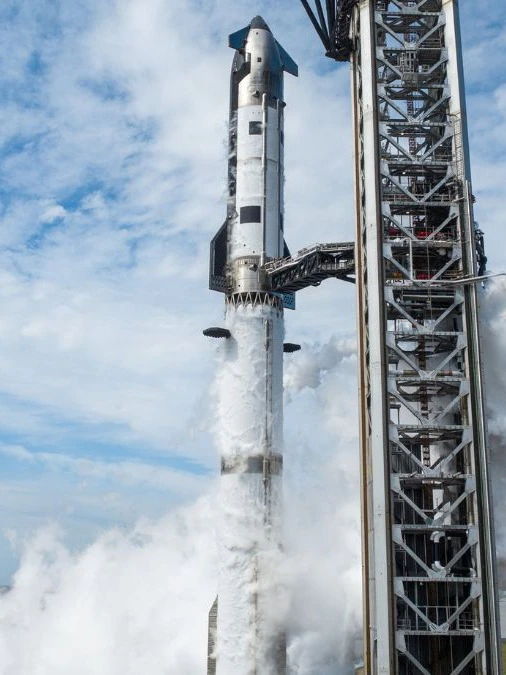
The uncrewed vehicle lifted off from SpaceX’s Starbase site in Texas at about 7:46 a.m. CT aboard the 407-foot-tall rocket, which combines the Super Heavy booster with the Starship upper stage. SpaceX later said in a post on X that payload deployment was complete and that all 26 Starlink V3 satellites were in orbit.
That payload matters more than the headline-grabbing size of the rocket. SpaceX says each of the 26 Starlink V3 satellites is designed to add one terabit per second of capacity to the company’s internet network. In aggregate, that is 26 Tbps of added capacity, which SpaceX says is about 10 times as much as a single Falcon 9 mission carrying V2 Mini Starlink satellites. For a U.S. tech audience, that is the business angle. Starship has long been pitched as the vehicle that could eventually open up Moon and Mars missions, but its near-term value is more terrestrial. If SpaceX can reliably launch larger batches of higher-capacity Starlink satellites, it can expand a broadband business that is strategically important to the company.
Until now, all 13 prior Starship flights since 2023 had been suborbital, according to the mission details. Flight 14 was set up to change that, with Starship expected to fly roughly 171 miles above Earth and complete about six orbits during a nearly 10-hour mission before splashing down in the Pacific Ocean west of Chile. There was still caution built into the profile. SpaceX said Starship would only perform its orbital insertion burn after flight controllers confirmed enough redundancy in the systems needed for the later deorbit burn. In plain English, this was an orbital mission with a safety gate tied directly to whether the vehicle could also come back in a controlled way.
That’s a telling detail. It shows how SpaceX is trying to move Starship into service without pretending the hard part is over. Reaching orbit is a milestone. Surviving reentry, protecting the heat shield, and proving the ship can be reused at meaningful cadence are still key issues if Starship is going to do what the company has long described. The mission also doubles as a Starlink deployment test and a diagnostic flight for the vehicle itself. SpaceX said the satellites would unfold antennas and solar arrays, establish initial contact with ground stations and the rest of the Starlink constellation through radio-frequency and laser links, then use onboard thrusters to raise their orbits and undergo checkouts. The company said the satellites should begin serving customers as soon as a few weeks after launch, following those on-orbit checks.
Three of the satellites carry cameras designed to look back at Starship after deployment and capture images of the ship’s heat shield. That is a use of the mission to gather engineering data. SpaceX is trying to learn not just whether it can put payloads in orbit, but whether the thermal protection system looks healthy enough to support the goal of bringing Starship back directly to its launch site.
The background
Monday’s flight also came after specific fixes to issues seen on Flight 13. During that mission, Super Heavy used all 33 engines for its boostback burn for the first time, but ice later clogged three center engines and ended the maneuver early. For Flight 14, SpaceX said it made hardware changes to improve engine filtering and software changes intended to improve relight reliability.
The heat shield got similar attention. SpaceX said it was testing additional mechanisms to keep tiles attached and curved tiles intended to reduce heating in the gaps between them. Two heat-shield tiles recovered from Ship 40 were reused on Ship 41, the first time Starship has flown with reused heat-shield tiles. That may sound minor next to a first orbital flight, but it is the sort of detail that helps determine whether reuse becomes a working manufacturing system.
There is also a broader market implication here. Falcon 9 remains the workhorse of the U.S. launch industry, and it has built its reputation on reliability and cadence, not raw size. Starship changes the equation only if it can turn its huge payload volume into lower unit economics for Starlink, larger single-mission deployments, and eventually missions Falcon 9 cannot do. The first orbital Starlink deployment is the first concrete hint of that strategy becoming visible in operations instead of presentations.
Competitively, this gives SpaceX a position that is hard for rivals to match in the near term. The company already controls both the launch stack and the satellite network. If Starship can carry larger, more capable satellites at scale, SpaceX is not just another launch provider. It becomes even more vertically integrated across rockets, spacecraft, broadband infrastructure and the customer-facing service itself.
At the same time, investors and operators should keep the caveat in view. One successful orbital mission does not erase the core execution risk. Starship’s future depends on repeating this profile, tightening reentry performance, and showing that upgrades like engine relight fixes and tile reuse are not one-off wins. SpaceX has been comfortable testing in public, but commercial markets usually demand something less cinematic and more boring: repeatability.
What's next
The immediate next trigger is the end of Flight 14 itself. SpaceX said the mission was designed to conclude with a single Raptor engine firing in space to leave orbit, followed by a controlled reentry and splashdown west of Chile. After that, attention will be on whether the 26 Starlink V3 satellites enter service within a few weeks as SpaceX expects, and whether the heat-shield imagery and tile-reuse data suggest Starship is getting closer to routine orbital operations instead of isolated milestones.
Frequently asked questions
Did SpaceX Starship reach orbit on Flight 14?
Yes. SpaceX said Starship reached orbit during its 14th integrated flight on September 28, marking the rocket’s first orbital mission. That is a major milestone in the company’s effort to make Starship operational.
How many Starlink V3 satellites did Starship deploy?
Starship deployed 26 Starlink V3 satellites on Flight 14. SpaceX said all 26 satellites reached orbit, making it the first Starship mission to place a Starlink payload in orbit.
Why is this Starship launch significant?
This mission is significant because it combined two major firsts for Starship: reaching orbit and deploying an operational-style satellite payload. It also shows progress toward using Starship for regular launches, including future Starlink missions.
Is Starship the world’s most powerful rocket?
Yes. Starship is widely described as the world’s largest and most powerful rocket based on its scale and thrust. That makes its first orbital mission especially important for the commercial space industry.
What are Starlink V3 satellites?
Starlink V3 satellites are a newer generation of SpaceX broadband satellites designed to expand the Starlink internet network. They are expected to deliver more capacity and improved network performance compared with earlier versions.
What does reaching orbit mean for SpaceX’s Starship program?
Reaching orbit suggests Starship is moving from experimental flight testing toward operational capability. It strengthens SpaceX’s case for using the vehicle for satellite deployment, deep-space missions, and future lunar and Mars plans.