Everyone has a foundational memory of borrowing a video game and discovering a whole new world. For me, it was Fallout. My friend Joe lent me an Xbox 360 copy of New Vegas: Ultimate Edition – the base game plus all the DLC on one handy disc – and over a weekend I became absorbed in Obsidian’s post-apocalyptic mojave. Since then, Fallout has become one of my favourite franchises. That memory serves as a good reminder that video gaming is an inherently shared experience, and borrowing games from one another is the purest form of that. It’s saying “I loved this experience, and I think you will too.”
PlayStation’s decision to end physical disc production in January 2028 may as well have been a decision to cleave that shared experience in two.
There is a kind of magic to physical ownership - the feeling of unwrapping a game for the first time on Christmas, flicking through the manual inside, discovering bonus goodies like a map or art cards. Many of those aspects have been eroded away by time and the push for cheaper production, but there’s one thing we’ve not lost quite yet: choice. You might keep that game for 10 years, or give it to a friend to play within 10 days; what happens to that game is up to you.
Whoever plays it next – whenever it’s played next – the beloved experience remains the same. A physical copy of a game is frozen in amber: they can never change. It’s the only way games like Grand Theft Auto 4, Alan Wake, and Tony Hawk’s Pro Skater 1 & 2 can maintain their original and often iconic music licenses – publishers can’t hijack them and remove the classic tracks because their deals expired.
But above all of this, ownership matters because it’s an investment. It’s an investment players themselves make in their life, because they believe in the video game experience. Whether you’re 15 years old picking up extra shifts at your first job or 50 years old blocking out a weekend to enjoy a long-awaited release; the future of what happens with that video game should lie with the person who’s bought it and them alone. So why are our video games slipping out of our hands now more than ever? To understand that, we need to understand DRM.
There’s a misconception amongst players that once you’ve bought a digital game, you own it. You don’t. DRM, or Digital Rights Management, is the process of being granted a ‘license’ whenever we purchase content through digital storefronts like the PlayStation Store or Steam. What you have bought is effectively a long-term loan from the publisher & store to the player. As a result, it can be taken away from you at any time.
The video game industry’s knotty entanglement with DRM has been ongoing for years, but it really ramped up in the 2010s, with publishers claiming the key purpose was to prevent piracy. Infamous incidents involving SimCity and Diablo 3 in the early 2010s, where ‘always-online’ DRM became a mandatory requirement for the first time, saw server malfunctions locking players out of their games entirely, whilst other times saw players log into games only to find their cloud-based saves had seemingly vanished into thin air. DRM games are like a penny on an invisible string - you pick something up that you think you’ll always have, only to have it suddenly snatched out of your hands with little choice but to accept what’s happened.
Take Steam for example – when you load up a game via Valve’s launcher, a hidden process happens between the storefront and the publisher. It essentially asks “is this person allowed to access this from you?” Think of it as millions of digital threads linking up to one big chain. All it takes is for the publisher to yank on that (or, indeed, to be dragged away by the ever-present financial turbulence tearing the industry apart) and everyone’s access disappears. If you were dining out, and halfway through your meal, the chef came out and took your meal away halfway through eating it, you’d be outraged. Why shouldn’t it be the same for games? Oftentimes when games are delisted, it’s due to copyright licenses expiring or simply a desire on the publisher-side to free up server infrastructure, regardless of the impact that may have on their customers. The list of games now near-extinct due to digital delisting is extensive – Spec Ops: The Line, Resident Evil: Operation Raccoon City, Deadpool and Super Mario Maker to name a few. Now with physical discs on the chopping block – the only format those aforementioned games can currently be found in if you didn’t purchase them digitally during their available window – we should expect this list to balloon exponentially.
So why is PlayStation doing this? It has claimed it’s merely following consumer trends. Unfortunately, this isn’t entirely incorrect. The physical video game market has been in a marked decline – in May 2016, consumer spend was just below $6 billion; as of May this year, it’s barely passed $1.5 billion (although it’s worth noting that was a 3% growth, the first year-on-year growth since 2009). In PlayStation’s case specifically, the shift becomes more pronounced – in 2016, 27 of every 100 PlayStation games were purchased digitally; as of this year, it is now 78 out of 100. Hardware leakers have also reported the PS6’s manufacturing costs are pushing close to $1000, and with PlayStation boss Hideaki Nishino stating that it’s “not realistic” for Sony to front these pricey component increases, streamlining the PS6 as a singular digital-only console would assist in lowering prices.
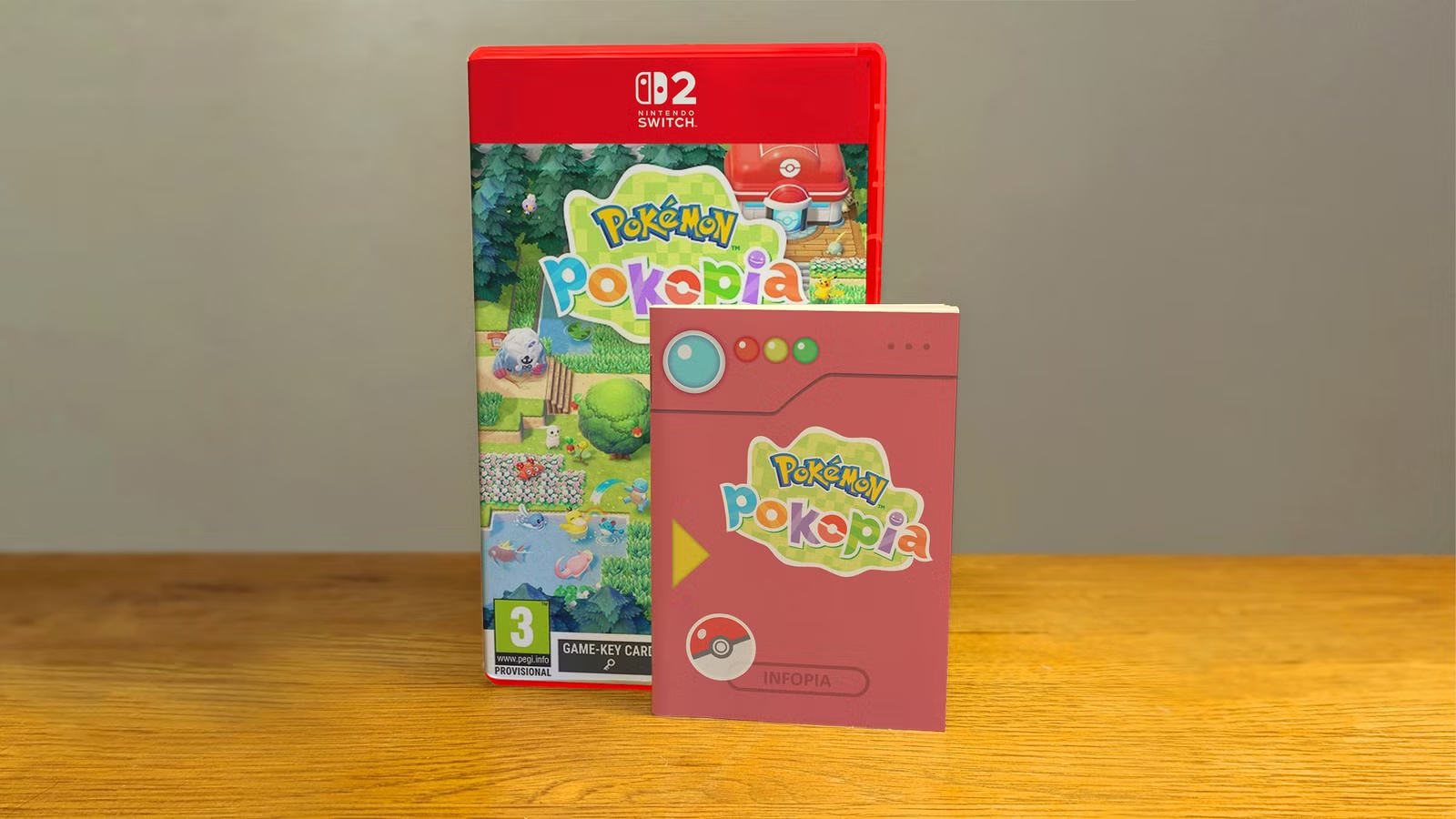
PlayStation isn’t alone in this – Nintendo’s game-key cards for the Switch 2 and Xbox’s over-reliance on Game Pass reflect an industry-wide shift toward a digital-only future. And it’s not just the publishers either – developers must bear some responsibility for injuring physical’s future, too. Over 22% of IO Interactive’s 007 First Light European sales were physical, which is a significant statistic in and of itself and a clear sign of a viable physical market. Except IO Interactive shipped a physical disc containing only the first mission, requiring players to download a hefty day one patch to actually make the game they purchased playable. What value does a physical disc have if it becomes just a download key? At least it can be borrowed by a friend, but its use for any owner disintegrates the moment something happens to the servers that First Light is stored on.
The end of disc production doesn’t just threaten borrowing, but potentially the entire second-hand market ecosystem. Many players over the years, once bored of their collection, have found their way down to a local GameStop in the U.S. or CEX in the UK to trade in their games, and in the process, collect a few new ones while they’re in-store. Think of them as recycling plants for video games – as one player closes the book on The Witcher 3, another opens that person’s case for the first time. Second-hand stores have served as gateways for players to experience the extensive back catalog of past and present consoles alike, often at an alluring discount.
Publishers have tried to throttle the second-hand market in the past, with the likes of EA gating on-disc content via one-time keys accessible in brand-new copies only – a system that meant any second-hand copy of Battlefield 3, for instance, couldn’t access the online multiplayer modes. But some have decried PlayStation’s decision as ringing the ultimate death knell for the second-hand market. At least you could play some of EA’s games without an online pass. Without physical discs, there is no second-hand market at all.
But it doesn’t have to be that way. One pathway forward could be through the creation of a fully digital second-hand marketplace. Digital game storefront Good Old Games has championed itself as the first fully anti-DRM retailer - essentially, even if games get delisted from their storefront, it doesn’t matter. If you download one of its games, you can keep it on a hard drive and play it – no internet connection required – forever. .
GOG’s approach could be evolved to give players even more autonomy. An online hub filled with individual user storefronts operated by players themselves – like a digital yard sale, players could browse one another’s wares, combing through for a good deal or a brand-new gem they’ve never heard of. Much like GOG’s extensive partnership program, or World of Books’s AuthorSHARE initiative, which donates a portion of all used book sales to the authors who originally penned them, publishers and developers could take a percentage of each sale in exchange for ensuring that ownership exchange of each digital title begins with the player handing it over and ends with the player purchasing it. No DRM middle-man in sight. This could also provide a second-life for pre-owned retailers like GameStop and CEX, thereby ensuring a key sub-section of the video game market continues to be served whilst, for the first time ever, actively incorporating the publishers and developers as financial participants. Idealistically, this could see a greater cash injection flowing into the industry, an alternative that would be much welcomed by many a developer over publishers’ hyper-focus on making their own live-service cash cow.
It’s far from the only solution, though. One alternative direction would be for players to seek out third-party alternatives to get their discs, like boutique publishing houses. Limited Run Games, Fangamer and Super Rare Games are just some of the companies whose mission statement is clear: to take digital games out of your console, and put something real back into your hands. Limited Run Games initially began with humble indie game origins and have since expanded to work with the likes of Capcom and SEGA, proving the feasibility of these companies to scale their operations to meet traditional brick-and-mortar publishers’ expectations. If PlayStation’s lack of disclosure over cutting disc production to its triple-A publishing partners is true, it could well be those same partners have just as strong a desire to continue physical publishing as their fanbases - making for a potentially very bright future for these boutique publishing houses (provided a disc drive add-on is made available for the PS6 – something you’d hope would happen, considering Sony’s extensive disc-based back catalog and the continued production of physical media movies).
PlayStation’s decision serves as a harbinger for a potentially dire future for gamers everywhere. It is entirely self-serving, and will have ripple effects throughout the industry that we can only begin to speculate on. The immense backlash on social media to PlayStation’s own social posts has become its own news story, and there’s always potential that such heavy negativity may cause publishing partners to hit pause on their PlayStation social marketing efforts. Gamers have every right to be angry – we’re being challenged on the future of our right to own the things we’ve paid for. Allowing this to pass unscathed would open the door to a myriad of worse decisions: things advertising during pause screens, and intrusive product placement throughout classic franchises. How we respond to this decision over the next year may define how the next decade of the video game industry is shaped. The official slogan of the PlayStation 5 is ‘Play Has No Limits’; if we don’t make a stand now, the PlayStation 6’s slogan might as well be ‘You’ll Play How We Want You to Play.’
Sab Astley is a freelance writer who has written for IGN, Polygon, TotalFilm, Rolling Stone, Radio Times, and Metro UK.
Source link